Paddock Trees Under Threat
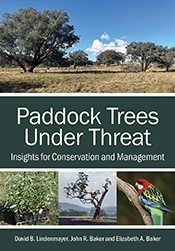
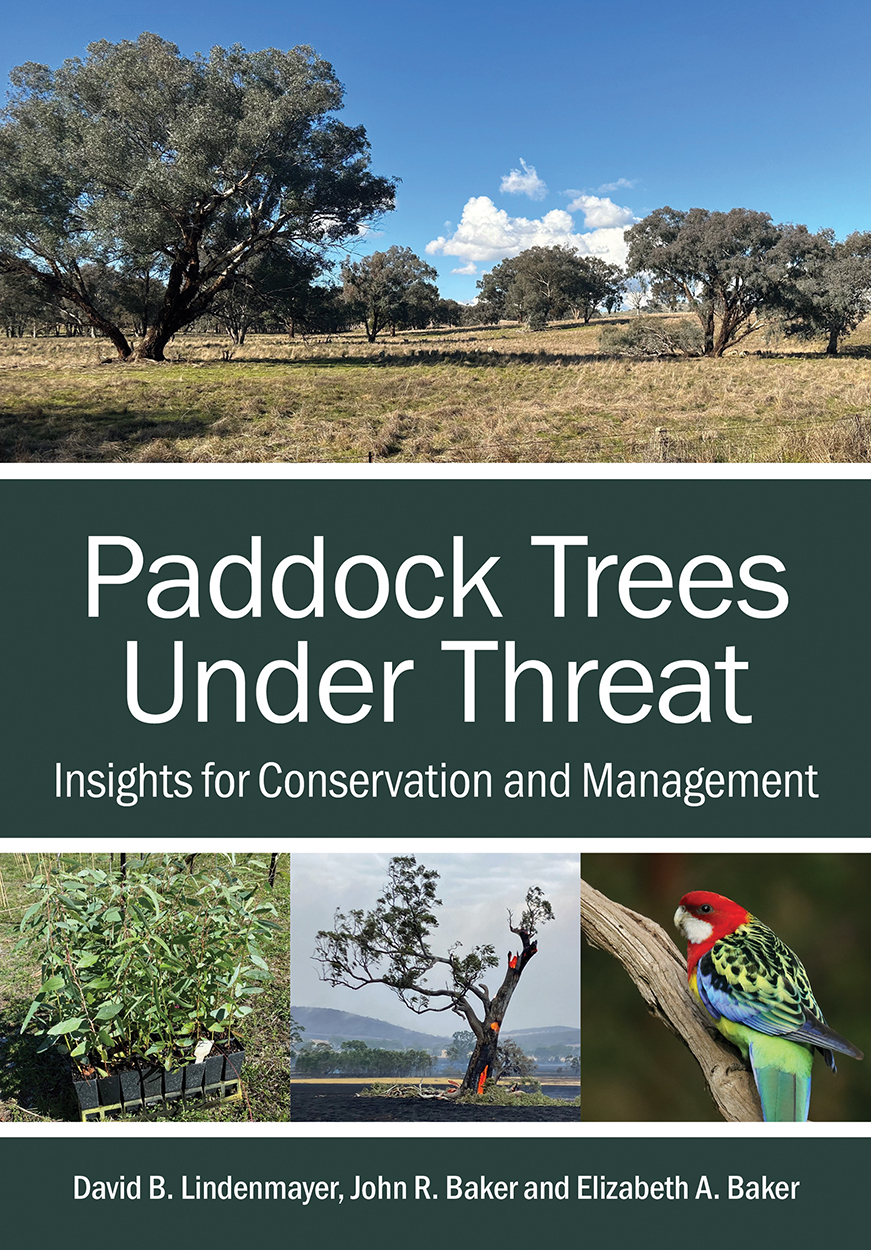
Insights for Conservation and Management
By: David B. Lindenmayer, John R. Baker, Elizabeth A. Baker


A guide for landholders and everyone interested in the conservation of paddock trees.
Scattered paddock trees, especially very large and old trees, are an integral part of inland farming landscapes in south-eastern Australia. They feed and shelter wildlife, act as stepping stones to connect landscapes, boost soil carbon and microbial communities, and hold deep cultural meaning for First Nations peoples as well as non-Indigenous Australians. Sadly, these trees are threatened and disappearing rapidly, and too few young trees are replacing them. Even dead trees are valuable for wildlife and should be retained where safe to do so. + Full description
Paddock Trees Under Threat explores the importance of these trees and the conservation measures required to save them. It discusses managed grazing, herbivore control, direct planting, and funding and community support. It also explains the need for policy change, including better land-clearing rules, financial incentives, better infrastructure planning, and research to guide planting in a changing climate. Using decades of on-ground experience and the latest scientific research, this concise and practical guide will be invaluable for landholders and others interested in the conservation of paddock trees.
- Short descriptionNews
Available as Print-on-Demand. Learn more.
Details
Paperback | September 2026 | $ 49.99ISBN: 9781486321278 | 232 pages | 244 x 170 mm
Publisher: CSIRO Publishing
B&W photographs, Colour illustrations, Colour photographs, Illustrations
Features
- Explores the ecological value of paddock trees, including food and habitat, landscape connectivity, soil carbon sequestration and microbiological activity.
- Outlines the significant cultural value and spiritual significance of paddock trees for First Nations peoples.
- Provides insights into the value of paddock trees for farm production and ecosystem services that paddock trees provide, with specific focus given to the agricultural landscapes of inland south-eastern Australia.
- Reviews the challenges of tree protection strategies for slowing the decline of paddock trees.
- Discusses the policy changes required to better manage, recruit and conserve paddock trees.
Contents
Acknowledgements1 Overview of paddock trees
2 International context
3 Paddock trees in south-east Australia
4 Paddock tree characteristics
5 Critical ecological and cultural values
6 Key production roles
7 Threats and threat mitigation
8 Encouraging new generations of paddock trees
9 Key knowledge gaps
10 Policies to protect and recruit paddock trees
Appendix: Examples of legislation relating to land clearing in New South Wales
Index
Authors
David B. Lindenmayer is a world-leading expert in ecology and resource management, conservation science and biodiversity conservation, with a prolific record of scientific works. He runs five long-term, large-scale ecological monitoring projects. His previous books include Rocky Outcrops in Australia, Natural Asset Farming, and Sustainable Farm Finance.
John R. Baker is a retired management consultant and former Australian ambassador who has 30 years of experience in planting and protecting paddock trees on a rural property in Central West New South Wales. He also has managed local Landcare projects on planting paddock trees.
Elizabeth A. Baker has long-term interests in botany, native plant conservation and local oral history. She worked closely with her husband, John, on a range of paddock tree planting projects.
Related titles